
The very first scene of Radiofreccia, a film that may not be a masterpiece but that certainly meant something to two or three generations of Italians, is a brief monologue by Bonanza, one of the characters who surrounds the story of the protagonist, Ivan, known as Freccia, and his group of friends. Placed at the center of an extremely tight shot, Bonanza says that «life is not perfect. Lives in films are perfect, beautiful or ugly but perfect. In film lives there are no dead moments, ever».
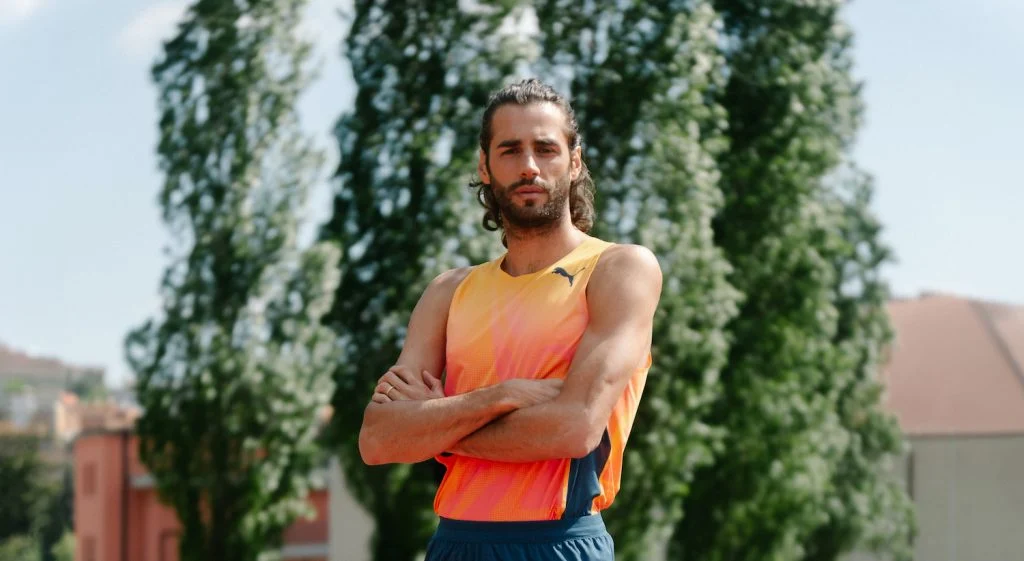
These three sentences are true for the overwhelming majority of human beings. Then there are the others, the people who live outside this majority: extraordinary people. And Gianmarco Tamberi, it can be said without fear of contradiction, is an extraordinary person. Because he is one of the most representative sportspeople in the history of our country, because he is Olympic, world and European champion (and champion of many other things) in the high jump. But not only that: Gianmarco Tamberi is an extraordinary person because his career and his life have a swirling and compelling plot, tragic and exhilarating, and he moves through them as if he wanted to go along with the flow, as if he were perpetually sitting on a roller-coaster train launched at extremely high speed. And so even a simple interview becomes a good opportunity to crack jokes, to tease and make fun of himself, to talk about his sport and the wonderful triumphs he has achieved and the intense pain he has had to face, about basketball, about what he does every day, the things he does not like doing, the films he likes – his absolute favorite is The Butterfly Effect with Ashton Kutcher – and everything that goes through his mind. Without filters, or almost. Without dead moments, ever.
Tamberi’s hunger for life also manifests itself before, during and after competitions. For him, the stadium hosting a major event – even an Olympic, world or European final – is as if it were the sports hall in Ancona where he goes to train every day, and vice versa. For example: a few weeks ago in Rome, just after winning his third European gold, he simulated an injury by throwing himself to the ground, took off his shoes, showed some springs he had hidden there, between his socks and the upper, and then jumped 2.37 in front of the crowd at the Olimpico, where, moreover, he had never won a major title; at the 2023 World Championships in Budapest, instead, he started playing the drums before the beginning of the competition and then won a gold that allowed him to equal a historic national record: before him, in fact, only one Italian – the middle-distance runner Alberto Cova – had managed to complete athletics’ grand slam, that is, to win the overall title at the Olympic Games, the World Championships and the European Championships.
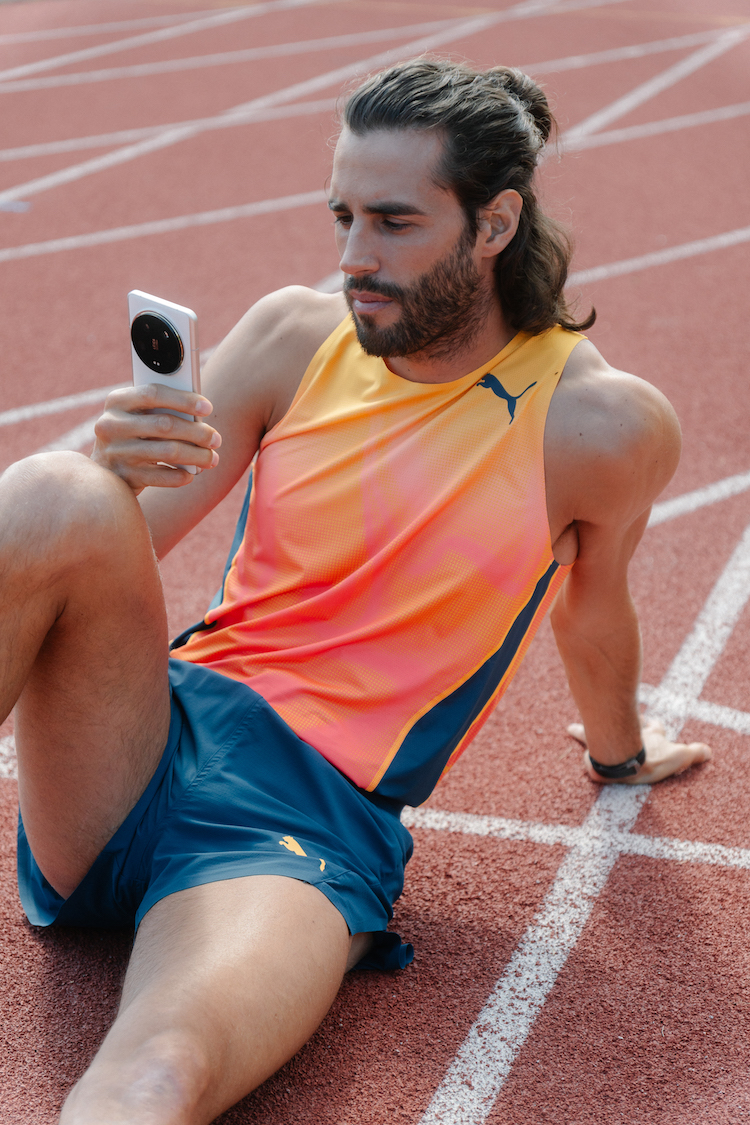
Tamberi’s theatricality and swaggering spontaneity appeal to many. But not to everyone. For critics, the Tamberi-character even ends up overshadowing the wonderful athlete he is, and has shown himself to be over the course of his career. Challenged on this point, Gianmarco answers clearly, straightforwardly. For him, his exuberance is a distinctive trait, a gift to be cultivated: «Being myself», he tells Undici, «is something I have focused on a lot. Often sportspeople struggle to be spontaneous, natural, especially at the most important appointments of their careers. Their fear is being judged, and social media have accentuated this concern. I, instead, believe it is impossible to be machines, all the more so when you are living through a moment in which years of work, of sacrifices, are at stake. Emotions are inside us, trying to limit them is a mistake in my opinion. Personally I have always tried to bring out everything I have inside, to show who and what lies behind the athlete. Over time, this way of doing things has brought me very close to the public: those who watch my competitions can see a boy in difficulty, even in tears at certain moments, but also a super-charged champion. That, I think, is how people can identify with me».
In light of these words, one is tempted to think that Gianmarco Tamberi is someone who does not care, someone who gives no weight to other people’s judgment. In reality this is only partly true: Tamberi, in fact, is perfectly aware of the time and world he lives in, of his condition as a media figure from whom it is right to expect positive messages. The point is that Tamberi sends a great many positive messages, and they are also inside the little shows he stages for his public. It is not Gianmarco who says this: others say it, the positive feedback that comes from his colleagues and his opponents and from the entire multiverse of sport says it. We all still have in our eyes the brotherly embrace between Gianmarco and Mutaz Barshim at the Tokyo Olympics, when both won the gold medal, then fifteen minutes passed and Tamberi was hanging from Marcell Jacobs’ neck to celebrate their triumphs in the high jump and the 100 meters, the most beautiful day in the history of Italian athletics; a few weeks ago, when the news came out that Tamberi would be one of Italy’s two flag-bearers at the Paris Olympics, Gregorio Paltrinieri – probably the only Italian athlete who could have been chosen instead of Gianmarco – wrote on Instagram that «a great friend of mine and an athlete I admire enormously has been chosen to be flag-bearer. And I can only be overjoyed for him».
Tamberi believes that all this friendship and all this affection are linked to his way of being, to the way he behaves: «My spontaneity has had an important weight and impact on my career. But you cannot be blind or stupid: it is clear that everyone likes being appreciated by others. So you have to be yourself, but you also have to be an example, especially for young people. I know I have responsibilities, I know these responsibilities must be honored. When I read or listen to words of appreciation from my younger colleagues/opponents, or from my national teammates, it pleases me a lot. Receiving positive feedback is always nice. In this sense, being the flag-bearer in Paris is an honor without equal. Honestly, I never thought I would reach this milestone».
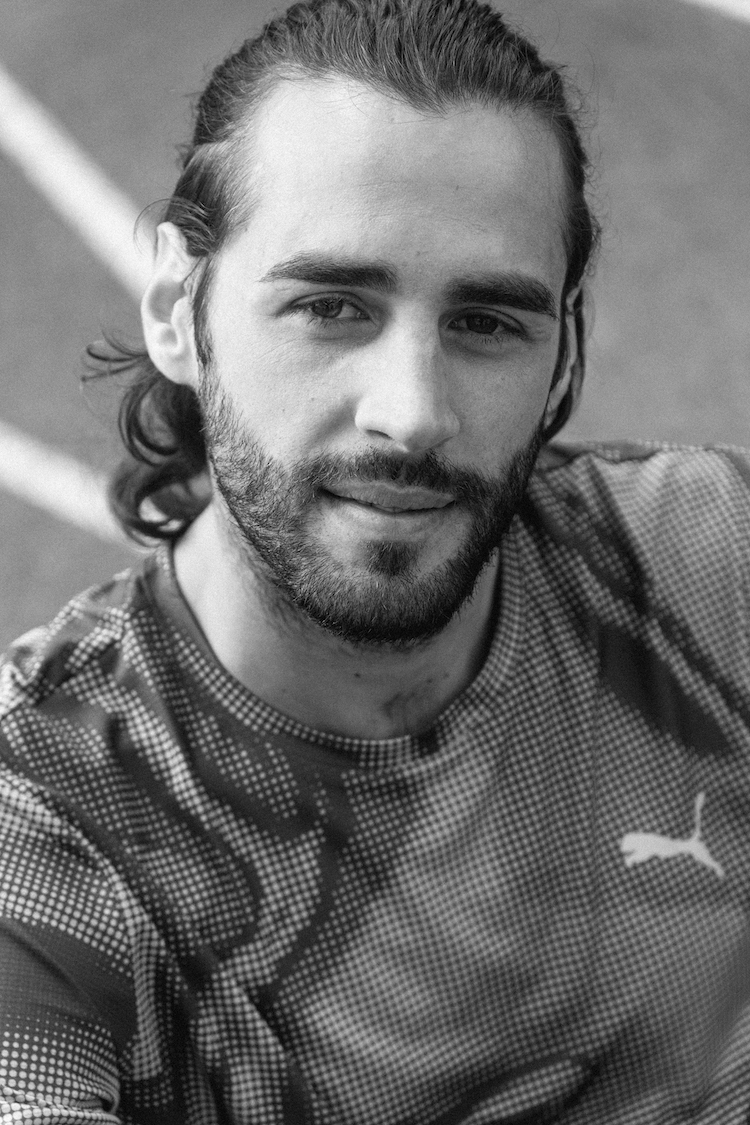
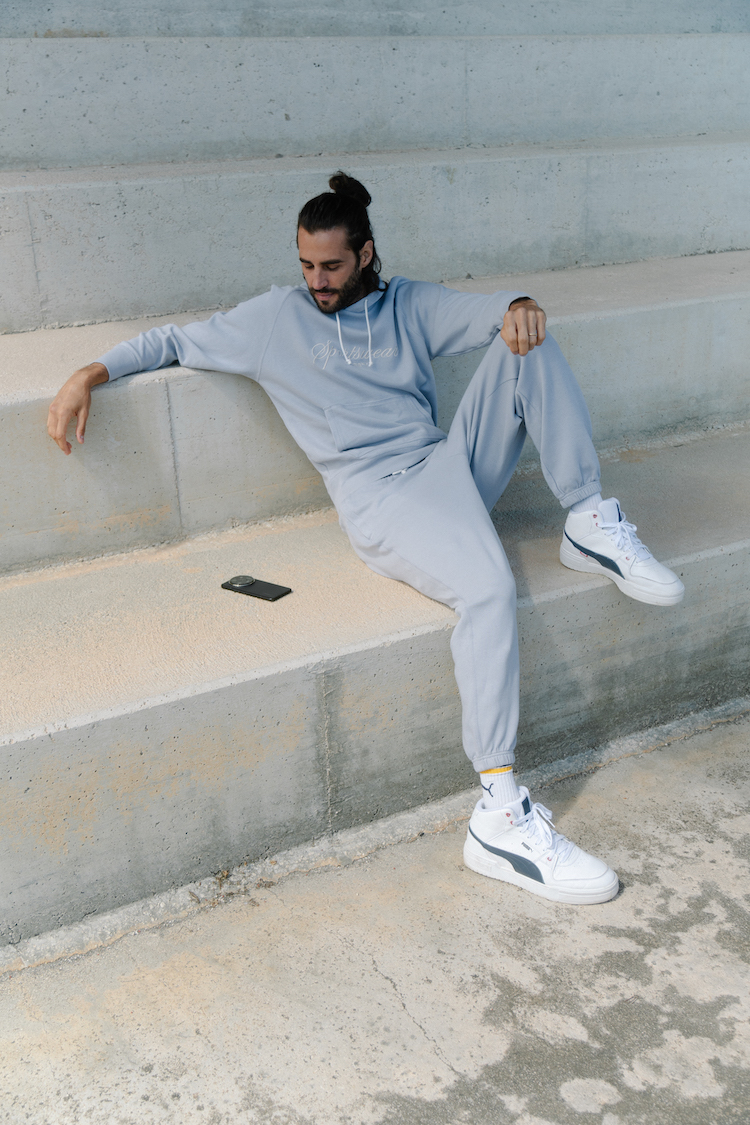
Very often, the journalistic narrative of sport moves in watertight compartments, if not actually along binary tracks. Among the most cloying clichés is the one whereby an exuberant athlete must also be light, frivolous, absent-minded, and there are no alternatives. From this point of view, Tamberi’s life and career tell a totally different story. This time, too, it is not him saying it: when you talk about Gianmarco with his wife Chiara, with a member of his staff, with anyone who really knows him, the first word they all use to describe him is maniac. «Gianmarco is a maniac about his sport», they add immediately afterward. But how and in what does this maniacal nature express itself? «My thoughts are constantly directed toward the high jump», Tamberi says. «I won’t say 24 hours a day because at a certain point I go to sleep, but for the rest of the time my brain always goes back to technical preparation, to athletic preparation, to the videos of jumps that I watch before going to bed and then go over again in my mind before falling asleep. My life is a continuous staying inside the bubble, in every choice of my day I think about the high jump, about what I can do to perform better in competition. Other people’s competitions are also a stimulus for me: as soon as I know that an opponent is competing, I do everything I can to watch him on TV. I need to know what condition he is in, what height he manages to reach, I always look for new inspiration by watching my sport. Then of course time changes perspectives a little: before I had to build my way of jumping, so I watched those who were stronger than me. Right now I am trying to perfect my jump, more than take inspiration from others».
In the account of the Roman night in which Tamberi climbed to the roof of Europe for the third time, the European Athletic website wrote that «Gimbo’s jumps are a pure demonstration of class». In fact, and you only need to watch the competition at the Olimpico again to realize it, Gianmarco is a high jumper with a graceful and at the same time powerful style, who manages to compensate for a physique that is anything but explosive with extremely refined technique, in every single aspect of his jumps. This attention to detail, even the smallest detail, is one of the best perspectives for understanding and explaining his successes: «If I found myself in a training camp with the best jumpers in the world», Tamberi says, «I would probably always come last in all the athletic tests. In terms of strength, speed and reactivity, I feel I am far behind my opponents. At the same time, however, I do not experience this gap as a flaw. On the contrary, for me it is a stimulus to push hard in training, to do as much as possible and close the distance».
According to Gianmarco, however, the key to his triumphs lies inside his head, that is, it must be found in his psychological strength, in what he himself defines as a true obsession: the desire to excel. «I love competition», Tamberi says. «I love testing myself, I love the contest, I love overcoming my limits. Since I started doing high jump, I have realized that the moment when I manage to achieve important results is when I set myself a challenge. I am a born competitor, as a child I would get angry even if I lost at odds or evens. And my greatest strength is precisely this: I want to do well and therefore I perform at my best when competitions become important, when the decisive moments arrive. This is true for all sports but even more so in the high jump, since we are talking about a sport in which, fundamentally, there is one single major competition every year, and that is where everything is decided. You can jump 2.40 all year, but if you do not clear the right height in the right competition, your season has gone badly. Doing well in meetings does not lead to winning anything concrete, if you then fail to perform at the World Championships, at the Olympics. From this point of view, I feel really strong».
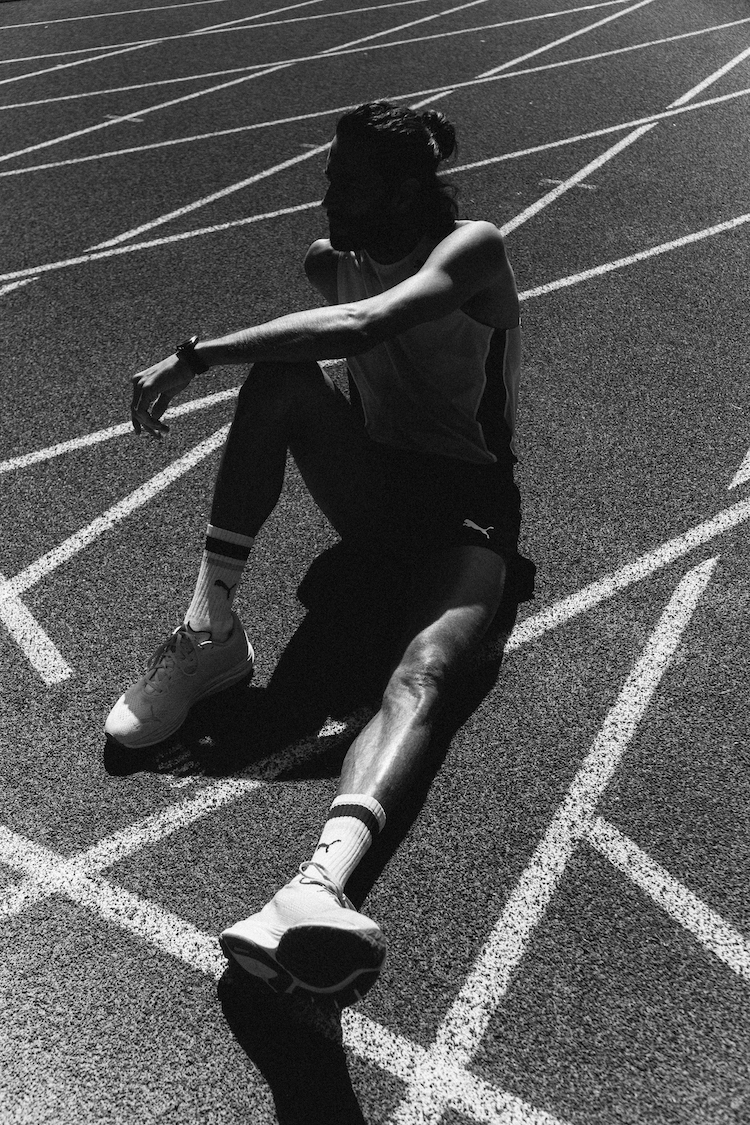
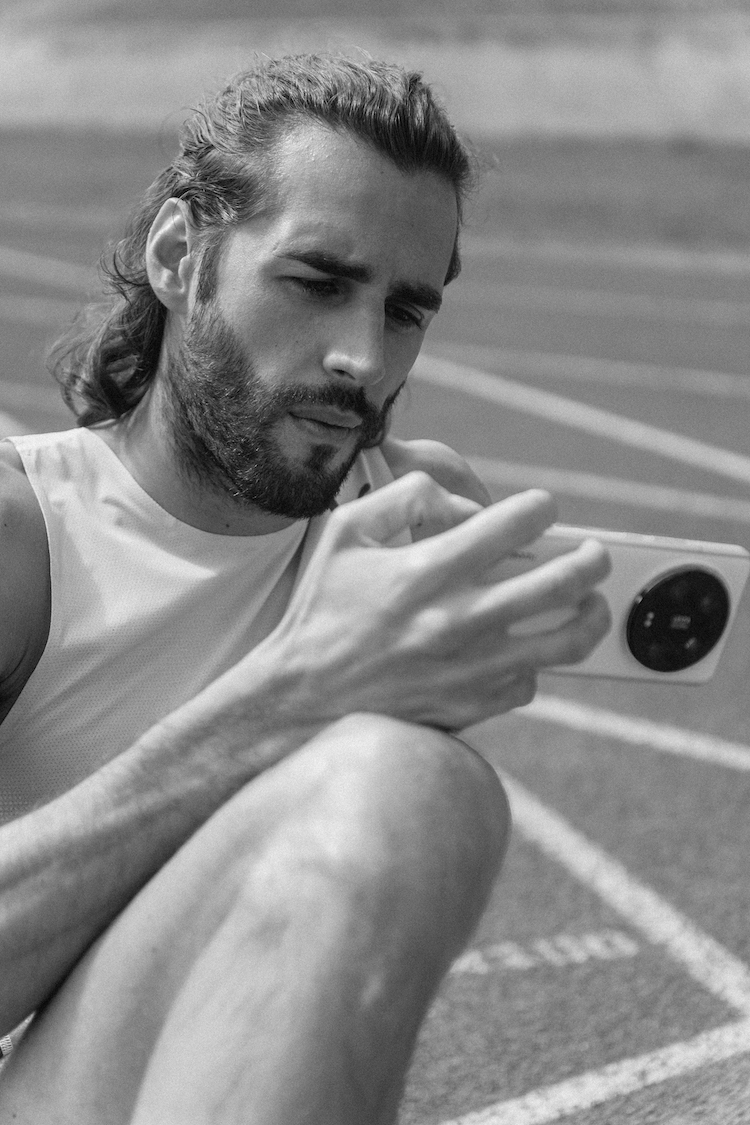
On one of the bars he uses when he trains in Ancona, the city where he lives with his wife, Gianmarco Tamberi has stuck a strip of masking tape. On this strip there is a handwritten note visible even from far away: Paris 2024. Not that there were any doubts about how much Gianmarco cares about the next Olympics, of course, but in a situation like this it is impossible not to return to the subject of his maniacal nature, his obsession with competition and victory: after all, Tamberi has already won everything he could win, he no longer has anything to prove.
Gianmarco’s problem, however, is that he himself thinks differently. And he has no problem admitting it, telling it: «I never look back, I always look to the next goal to reach, the next record to improve, the next competition to win. This is probably the worst way to enjoy a career in professional sport, but it is also the best approach if you want to achieve the maximum. And then it is a matter of motivation. If I look toward Paris, I have a huge amount of it, and it is all enormous: if I won, I would become the first high jumper of all time to win two consecutive golds at the Olympic Games; and then, possibly, I could celebrate together with the people who love me, the people who were not in Tokyo because of health restrictions, the people who had come to Rio to support me, except that in that case I was the one who was missing. Many friends had bought tickets, had traveled all the way to Brazil, they were supposed to cheer for me and instead I found myself sitting next to them watching the competitions. So now those same people will be in France together with thousands of other fans. How could I not have motivation?».
Being a superstar and having so much motivation also means having to live with the weight of expectations, of pressure. From this point of view, Tamberi has a clear and also rather personal view of his condition: in an interview given several years ago to the Corriere della Sera, he explained that «I do high jump because I am good at it, not because I love it»; during the breaks in the shoot you see on these pages, Gianmarco explained how difficult it is for him to give up eating what he wants in the periods of maximum effort, those in which he has to push harder in training.
So, precisely: sacrifices and difficult decisions are a very important part of his work. Especially in a season that will culminate with the Olympic Games: «Athletics», Tamberi says, «is different from other sports. The training we do cannot be a fun moment; those who practice it know very well that the moment to play will never arrive, even just to train, as instead happens to footballers, volleyball players, tennis players. I would never invite a friend of mine to do a set of repeated bounds, because he would get bored. For those who do high jump, then, getting into condition means pushing the body to the limit. Sometimes even beyond it. And so making sacrifices and experiencing them well is fundamental. I, for example, skipped the indoor events this year in order to eliminate risks ahead of the Olympics. In short, I had to give up one of the few fun moments in our discipline. I hope at least that in the end it will be worth it. But I will only be able to say that after Paris. Only after what will probably be the last Olympics of my career». Only after one last ride on the roller coaster, obviously launched at full speed.