
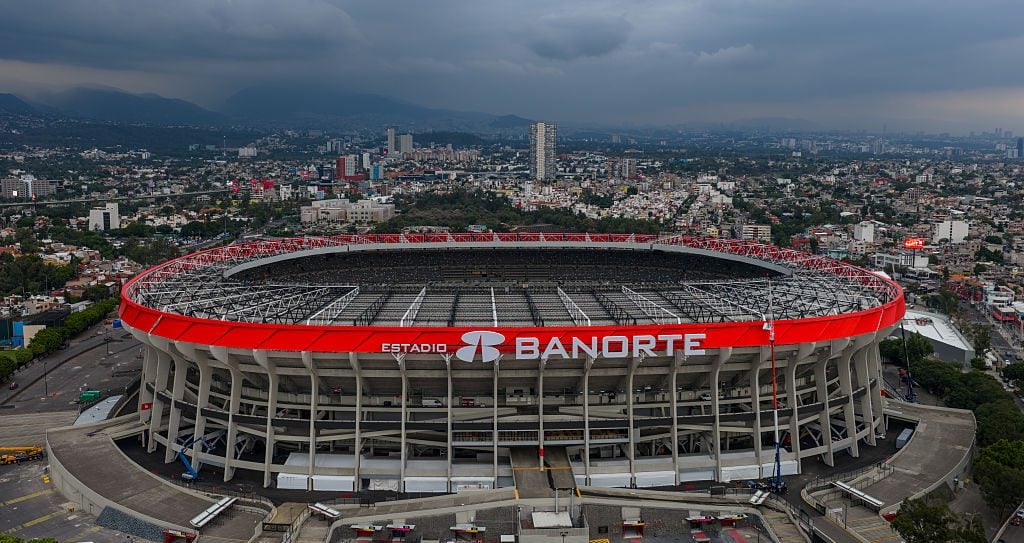
Few football stadiums in the world carry as much prestige as Estadio Azteca. The Match of the Century, the Goal of the Century. And now, in a new millennium, another world-stage chapter worthy of this place is expected. In the meantime, the stadium has changed, renovated itself, and accelerated a massive redevelopment process in order to secure FIFA approval ahead of the next World Cup. The good news is that, with less than a month to go, everything is finally ready. The bad news is that in order to make the Azteca fit to host matches at the upcoming World Cup, the stadium — or rather those responsible for overseeing its renovation — have scorched the earth around it.
The story has spread from Mexico all the way to Spain, where El País reported on the struggles faced by residents living near the Azteca. The neighborhood is called Santa Úrsula de Coapa, a relatively small residential district — around 11,000 inhabitants compared to the stadium’s 87,500 seats — but also a tightly knit, strongly working-class community. And the problem, even more than during the previous World Cups hosted by Mexico in 1970 and 1986, is that the urban impact generated by the stadium has spiraled beyond all expectations.
At first glance, what stands out is the unusually clean streets and the lavish promotion surrounding the event: the glossy image FIFA and local organizers want to present to the world. But behind the scenes, the picture is far more disturbing, exposing a long list of building abuses and very real consequences for local citizens.
The World Cup — predictably — caused property values in the area to skyrocket. The result: new buildings began appearing everywhere, often without the necessary permits and following the classic pattern of corruption. Investors buy plots of land for a handful of pesos, change their zoning through the complicity of local authorities — Mexico currently ranks among the world’s most corrupt countries according to international indexes — and within a few months, once luxury apartment blocks are built, the financial value of those same areas multiplies dramatically. Dirty magic.
And the people paying the price are primarily the residents of Santa Úrsula de Coapa and the neighboring districts of Huipulco and Pedregal de Carrasco. Their modest homes pale in comparison to the massive developments built for the World Cup — or, in the worst cases, are demolished altogether to make way for them. Evictions and unsustainable rent increases have become routine.
The underlying issue is that the local population, naively hopeful they might at least receive some small economic benefit from hosting an event of such global scale, instead find themselves trapped in their own neighborhoods. “These people are getting rich at our expense,” is the recurring accusation from residents, with virtually no positive impact even in terms of infrastructure.
The paradox is that beyond the dazzling new buildings, these neighborhoods remain poor and neglected, burdened by unresolved issues — above all, the lack of a reliable water supply in most existing homes. Meanwhile, one of the area’s most important wells has belonged to Televisa, the owner of the Azteca, since 2019 — just months after the World Cup was awarded to Canada, Mexico, and the United States.
Residents’ frustration is further intensified by the total inaccessibility of the stadium itself. During the 1970 and 1986 World Cups, local people could still sometimes get into matches thanks to word of mouth or the leniency of security staff. Today, however, control over the site is absolute.
For eighteen months of construction work, residents endured severe air and noise pollution, alongside worsening water shortages. And now, like ghosts, they will have to watch from afar as the glamorous global spectacle unfolds right before their eyes.
Speaking of groundwater: recent satellite measurements have shown that the Azteca is sinking at a rate of about one and a half centimeters per month, precisely because of underground water extraction. It should not pose a critical problem during the World Cup itself, but in the long term it almost certainly will. According to local engineers, the only possible — or impossible — solution is “to stop extracting water. And at that point, we’ll drink tequila.”