
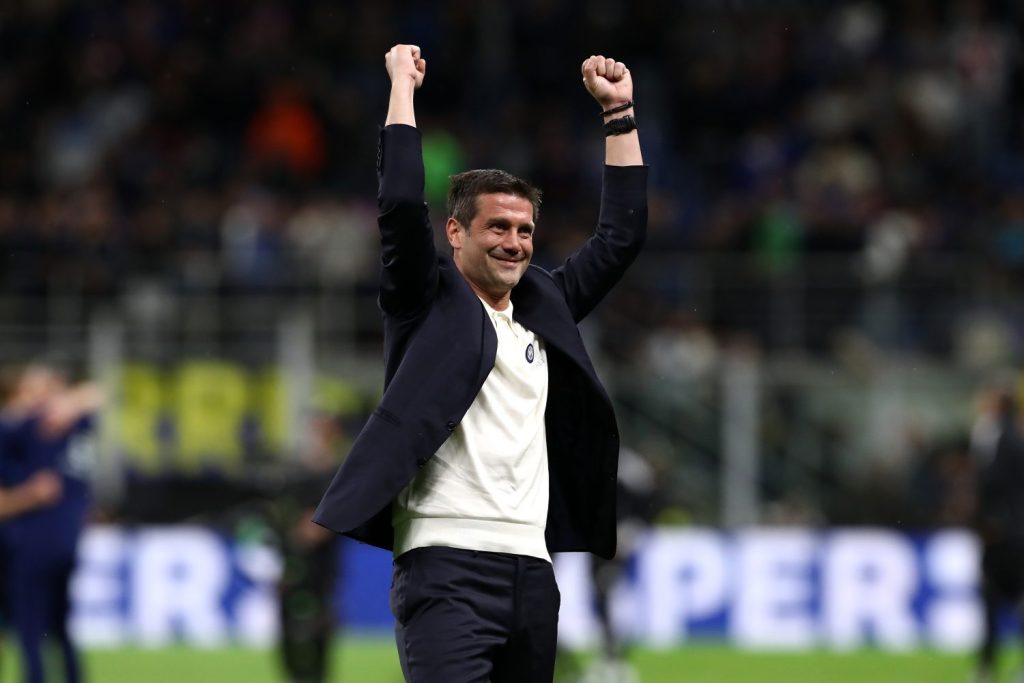
Some stories begin in silence, almost in a whisper. Not with booming proclamations, but with measured words, chosen with care. This is how Cristian Chivu’s story at Inter began: away from the blinding spotlight, yet already deeply rooted in a clear vision. It was June in the United States, the heat was intense, and the Nerazzurri were about to start the Club World Cup. In his introductory press conference, Chivu didn’t talk about revolutions or miracle formations. He spoke of belonging. Of Interismo. Of that sense of identity that he himself had embodied between 2007 and 2014, the years he defended the club’s colors as a player until his retirement.
They seemed like words chosen merely to rally the environment, but they were, in fact, the blueprint for his management. The Inter that Chivu inherited was no ordinary team. It was a wounded group, coming off an exhilarating yet exhausting season played on three fronts but concluded without silverware. A team clearly aching from an open scar: the five goals conceded in the Champions League final against PSG in Munich. That final “is not a journey to be thrown away, but a reason for pride,” Chivu repeated constantly during his first days. And that is exactly where he started: from the mind, even before the pitch. During the American training camp, instead of just drills, there were long sessions of dialogue. Constant discussions, both collective and individual. Chivu rebuilt the team piece by piece, as one does with something fragile. He listened, he spoke, he empowered. He restored confidence to a group that seemed to have lost it.
Tactical Intelligence
Then, of course, came the tactical work. But here lies one of the most interesting keys to his season: Chivu did not overhaul Inter. He tried, yes, at the beginning. He tested different solutions: two pure strikers, or a system with an attacking midfielder behind Lautaro Martinez. Legitimate, perhaps even fascinating ideas—but they weren’t sustainable. The signs were clear: two goals conceded against Udinese, four against Juventus. A team that was unbalanced, stretched, and vulnerable. And so, Chivu did what distinguishes intelligent coaches from ideologues: he changed his mind. Without stubbornness, he returned to the 3-5-2: more solid, more recognizable, but not identical to the previous version.
Within that seemingly conservative structure, he inserted new, subtle, but decisive details. The first concerns Bastoni. Under Chivu, his offensive runs are no longer automatic or hard-coded, but discretionary—a choice made by the player, not a requirement imposed by the system. This made the team less predictable and, above all, more balanced during transitions. The second key element is the playmaker (regista), positioned more vertically and pushed forward by about ten meters. This modification had a dual effect: it sped up the buildup and allowed for the recovery of Zielinski, adapting him to a more congenial role—especially when Calhanoglu was absent. Inter’s central midfielder evolved: no longer just a deep-lying metronome, but a creator and an accelerator of the game in more dangerous areas. Finally, a less frequent but significant solution: relying on the physicality of Pio Esposito as an outlet—an alternative option to bypass pressure and vary the attacking plan.
The Style of a Leader
Small variations, not revolutions. But this is precisely where a coach’s sensitivity is measured: in understanding what to change and what to preserve. And while Inter found balance on the pitch, another novelty took shape off it: Chivu’s communication. Calm, elegant, never over the top, yet far from weak—in fact, often sharp and always in defense of the club. After the match against Como, when the Scudetto was within reach, he aimed a jab at his two main rivals, Conte and Allegri—two managers who rarely overstep: “I’ll do like my opponents; I’ll just say we’ve achieved Champions League qualification.” Subtle irony, but effective.
When the “Bastoni case” erupted—following the simulation against Juventus that led to Kalulu’s red card and a media firestorm—Chivu did not hide. “Inter has been subjected to a media pillory,” he explained in the press conference. Strong words, different from those used until then. Spoken with firmness, not anger. He defended Bastoni, he defended the team, he defended the club environment, and he didn’t forget those who, in the summer, had underestimated his Inter: “There were some who placed us eighth in the title race grid,” he reminded everyone several times during the season. Without raising his voice, he made sure the message hit home. In this, many saw echoes of José Mourinho. Not so much in the tone, which is very different, but in the will to protect the group and create a “compact front” against the outside world. It is no coincidence that Mourinho was the coach with whom Chivu experienced the pinnacle of his career, the 2009/10 Treble. A legacy that, in some way, has re-emerged.
But it would be reductive to stop at references. Because Chivu has built something of his own. He took a wounded team and made them champions of Italy for the twenty-first time. With patience, intelligence, and consistency. He restored the centrality of the “group” concept. He gave meaning back to the word Interismo, transforming it from a slogan into a daily practice. The Scudetto is the finish line of a journey built day by day, as if closing a circle that opened during those hot June days in the American retreat. Chivu, who started almost in silence, succeeded in something rare: not only winning but making himself loved—by his players first, and then by the entire Nerazzurri world. Just as he had promised, moving quietly, without causing a stir.