
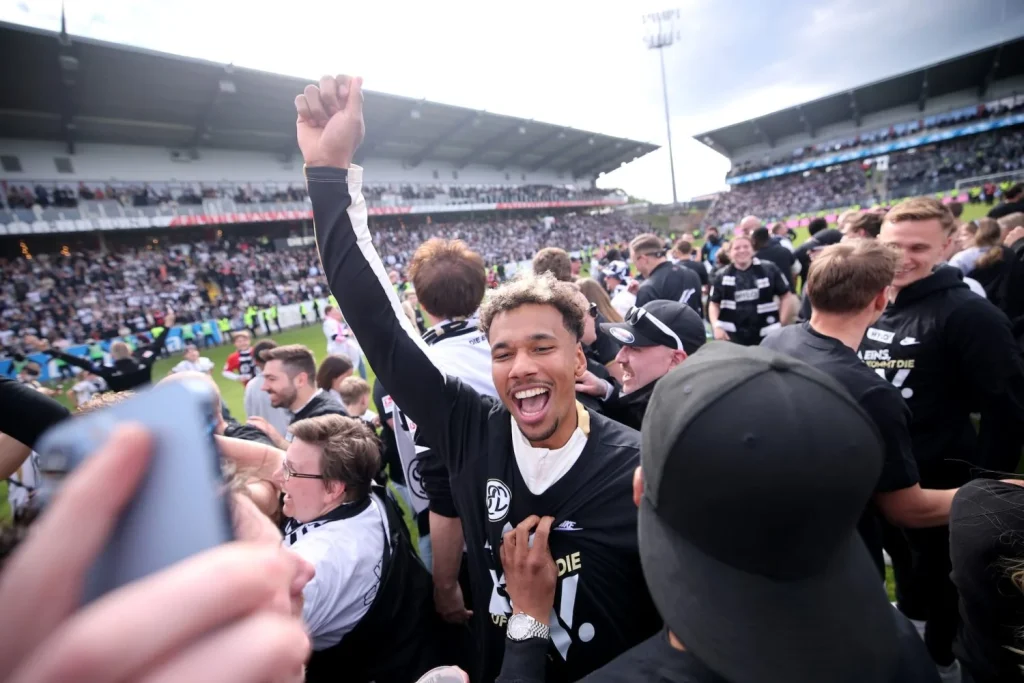
For the first time in its history, SV Elversberg will play in the Bundesliga. And this is huge news — enormous, in fact. Yet it is inversely proportional to the size of Elversberg itself, a town of fewer than 13,000 inhabitants located in southwestern Germany, in the state of Saarland, just a few kilometers from the borders with Belgium and France. To give a sense of the scale of the place: Spiesen-Elversberg — the town’s full name — does not have a railway station, a cinema, a theater, a shopping mall, or even a medium-to-large hotel. And yet, somehow, it now has a club competing in the top division of German football.
Even though it represents such a small community, Elversberg is the embodiment of a clear and ambitious sporting project. Let’s start with its institutional structure: the club is actually an association made up of 7,500 members who democratically elect its leadership. Today the club is led by Dominik Holzer, whose father owns Ursapharm, a pharmaceutical company headquartered in Spiesen-Elversberg and also the team’s sponsor.
Founded in 1907, Elversberg has completed an astonishing rise through the football pyramid, earning three promotions in the last five seasons. Last year the club already came within touching distance of the Bundesliga: after losing the promotion playoff against 1. FC Heidenheim, the team stayed true to its vision and bounced back with consistency, eventually securing a deserved second-place finish behind FC Schalke 04 — whose Veltins-Arena could fit the entire population of Spiesen-Elversberg five times over.
The decisive moment came on the final matchday, with a convincing 3–0 win over Preußen Münster, already relegated to the 3. Liga. At the final whistle, celebrations erupted as fans flooded the pitch at the Waldstadion an der Kaiserlinde.
What makes the story even more fascinating is that Elversberg could, in theory, have ended up playing in France rather than Germany. After the First World War, the Saarland region was placed under League of Nations administration for 15 years. It later became part of Nazi Germany under the name Westmark Province and, after World War II, turned into a French protectorate between 1947 and 1956. During that period, Saarland even created its own football league and national team, which was affiliated with FIFA and participated in qualification for the 1954 World Cup. Only in 1957 did Saarland officially become a federal state of West Germany — and later, from 1990 onward, of reunified Germany.
Elversberg will therefore become the 59th different club to compete in the Bundesliga, and only the second from Saarland after 1. FC Saarbrücken, which represents the state capital and currently plays in the third division.
To do so, however, the club must meet certain minimum standards. The Deutsche Fußball Liga requires a stadium capacity of at least 15,000 seats for Bundesliga participation, while the Waldstadion currently holds just over 10,000. Renovation works have already begun, and by next spring Elversberg will therefore have a stadium with more seats than people living in the town itself.
For Elversberg and its residents, the upcoming season will go down in the history books. A result that feels almost cosmic — just as the club’s manager Vincent Wagner described it: “Before the decisive match,” he said, “a friend told me that Elversberg getting promoted would be like going to the moon. Well, we’ve completed the moon landing.”